AI is making creative production cheaper, faster and easier.
An image that once took hours can now take minutes. A campaign concept can be explored in dozens of directions before a creative team has finished its first coffee. Interfaces, videos, copy, illustrations and even product concepts can be generated almost on demand.
So here is the more interesting question:
If creating becomes abundant, what becomes scarce?
That question matters more than whether AI will replace designers, writers or other creative professionals.
Because markets rarely reward what is abundant.
They reward what is difficult to find.
The new creative problem isn't making more. It's making something that matters.
For decades, creative industries were constrained by production.
You needed designers to design, writers to write, photographers to shoot, animators to animate and developers to build.
AI is removing many of those constraints.
That changes the economics of creative work.
When almost anyone can produce a reasonably good visual, write a decent piece of copy or generate a functioning interface, production itself becomes less valuable as a differentiator.
The question shifts from:
“Can you make it?”
to:
“Do you know what is worth making?”
And that is a very different skill.
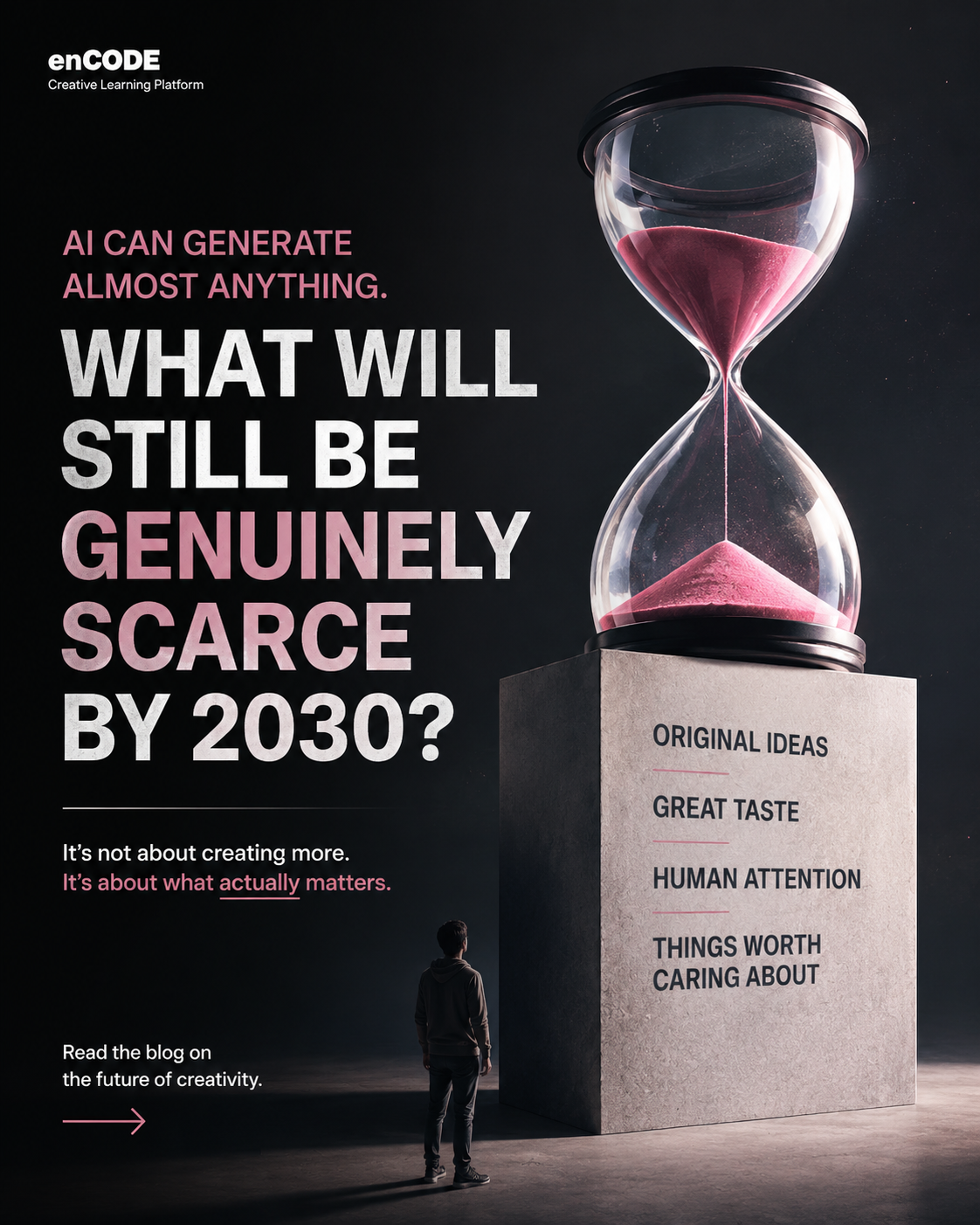
Four things that may become genuinely scarce
1. Original ideas
AI is exceptionally good at generating variations.
But variation isn't necessarily originality.
Give an AI a familiar visual language and it can produce hundreds of combinations. Give it a popular campaign format and it can create dozens of alternatives.
The problem is that the more content we generate from existing patterns, the easier it becomes for everything to start looking familiar.
By 2030, the scarce resource may not be ideas — it may be ideas that genuinely change the conversation.
2. Great taste
Taste is difficult to automate because it isn't simply about knowing what looks good.
It's about knowing why something feels right for this audience, this moment and this context — and why another technically impressive option should be rejected.
AI can give you options.
Someone still needs to decide which option deserves to exist.
As AI-generated work becomes more common, taste may become one of the clearest signals of professional value.
Not because AI cannot produce beautiful work.
Because beautiful work is becoming easier to produce.
Judging what deserves attention becomes harder.
3. Human attention
This may be the biggest one.
The internet already has more content than anyone can consume.
AI is about to multiply that supply.
More images. More videos. More campaigns. More posts. More products. More ideas competing for exactly the same 24 hours of human attention.
Our ability to consume doesn't increase at the same rate.
That creates a strange future:
Creative production becomes abundant while human attention becomes increasingly scarce.
In that world, the question isn't simply “Can we create something?”
It's:
“Can we create something someone will stop scrolling for?”
4. Things worth caring about
This might be the hardest one to quantify.
A product can be beautifully designed.
A campaign can be perfectly executed.
A film can be technically flawless.
And people can still feel nothing.
The next decade may therefore create an unusual premium on meaning, relevance and emotional connection.
People don't necessarily need more content.
They need more reasons to care.
So what happens to creative professionals?
This doesn't mean execution stops mattering.
Craft will still matter. Design fundamentals will still matter. Writing will still matter.
But the value chain is likely to change.
A professional who only knows how to produce may find their advantage shrinking.
A professional who knows what to produce, why to produce it, who it is for and how to make it matter may become significantly more valuable.
That's a very different definition of creativity.
And it applies far beyond graphic design.
The real creative advantage in an AI-native world
The obvious response to AI is to learn more AI tools.
That's useful.
But it may not be enough.
If everyone has access to the same models, the same generation capabilities, and increasingly similar workflows, the tool itself cannot remain the differentiator forever.
The advantage may instead come from the combination of:
Taste + curiosity + domain knowledge + cultural awareness + judgment + the ability to collaborate.
Our prediction for 2030
By 2030, we may look back at today's obsession with AI-generated content in the same way we look at the early days of the internet.
We were fascinated by the ability to create more.
Eventually, the bigger question became:
What is actually worth creating?
AI could make creative production almost limitless.
But originality isn't limitless.
Attention isn't limitless.
Taste isn't limitless.
And neither is people's capacity to care.
That's why the most valuable creative skill of the next decade may not be the ability to make more.
It may be the ability to make something that matters.