
What Happens When AI Can Spend Your Money?
AI can already write emails, plan trips, compare products and recommend what to buy. But there has always been one thing we still had to do ourselves:
Pay.
AI could find the shoes and compare prices. But when it came to spending ₹4,299, you still had to press Pay.
That may soon start changing in India.
Reports suggest that the National Payments Corporation of India (NPCI) is working on a framework that could allow AI agents to make certain UPI payments on behalf of users, with controls such as spending limits, identity checks and transaction records.
And that leads to a bigger question:
What are we comfortable allowing AI to do without us?
From assistant to agent
An assistant waits for you.
You say:
“Find me a flight to Mumbai under ₹6,000.”
An agent could potentially go one step further:
“Find me a flight to Mumbai under ₹6,000 and book it.”
It doesn't just tell you what to do. It does it.
Now add money.
You could tell an AI:
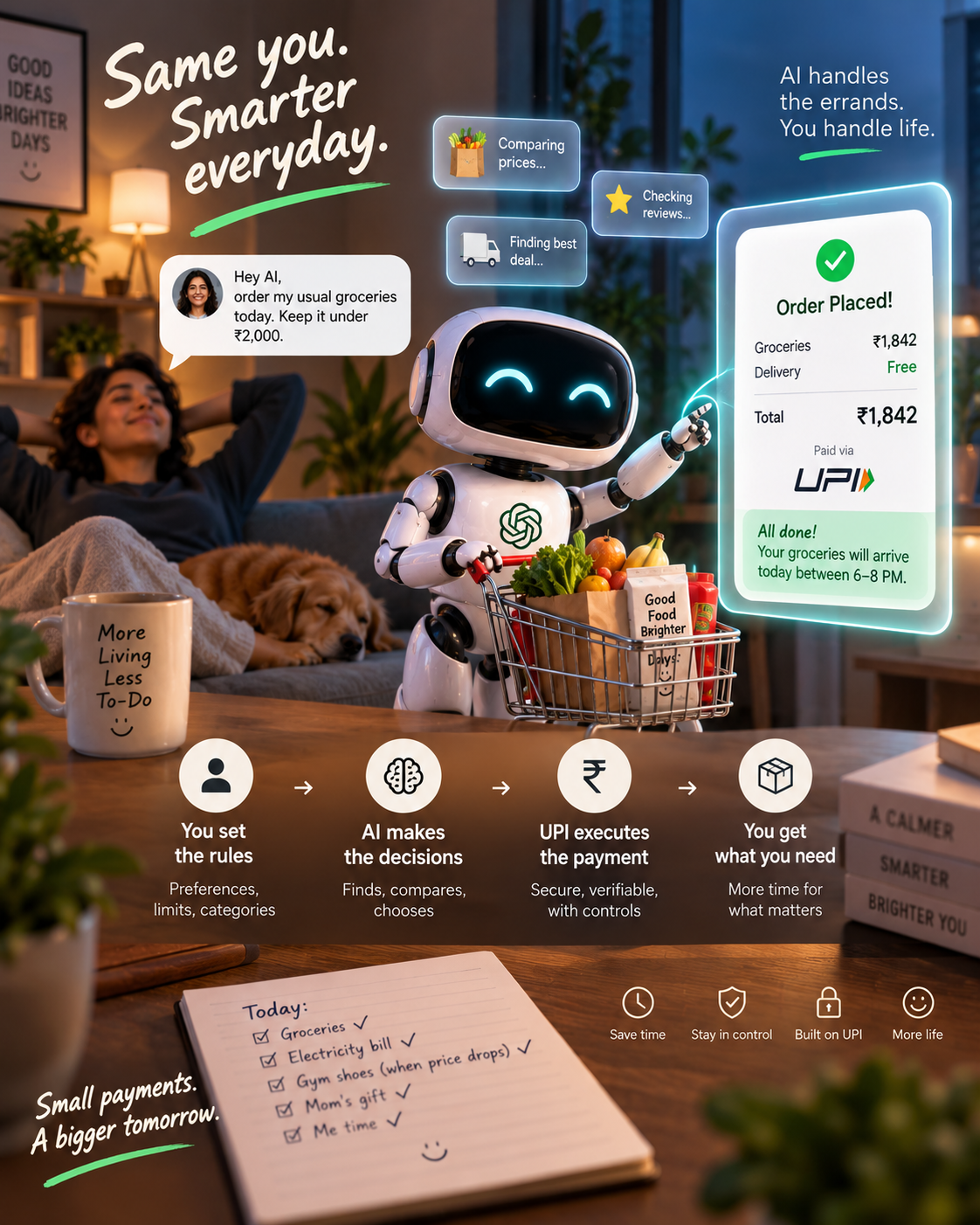
“Order my usual groceries every Sunday. Keep it under ₹2,000.”
Or:
“Pay my electricity bill automatically if it's below ₹3,000.”
The AI finds the option, decides and pays.
That's the shift.
Why UPI makes this interesting
This isn't happening on some new payment system nobody uses. It is happening around UPI, which Indians already use for everyday payments.
UPI processed 24.51 billion transactions worth ₹29.82 trillion in August 2026, according to Reuters.
So imagine the next step:
What if you don't have to make the payment yourself?
The reported Unified Agent Protocol (UAP) is expected to work with UPI infrastructure to identify and control AI agents.
But the bigger change isn't convenience.
It's delegation.
What if AI gets it wrong?
We already let technology make some financial decisions for us. Subscriptions renew and bills get paid automatically.
So why is giving similar authority to AI different?
Because AI has to make decisions when things don't go exactly as planned.
Imagine you tell your AI:
“Buy milk if it's below ₹60.”
Your usual brand is unavailable. Another brand costs ₹65.
What should it do?
A person might think, “It's only ₹5 more. Just buy it.”
But an AI needs rules.
Imagine your AI orders groceries for ₹1,950 from another seller because your usual store is out of stock. The seller is unreliable and the groceries arrive late.
Who is responsible — you, the AI company, the payment provider or the seller?
That's why AI payments aren't only a technology problem.
They're a trust and accountability problem.
Maybe the most important feature will be a “Stop” button
Digital products have spent years removing friction: fewer clicks, fewer passwords, one-tap payments.
But when AI spends your money, some friction might actually be useful.
For example:
Under ₹1,000: AI can pay automatically.
₹1,000–₹5,000: AI can find the best option, but ask before paying.
Above ₹5,000: Always ask.
You might trust AI with groceries but not with a laptop or a holiday.
So the future may be selectively frictionless.
You decide where AI gets freedom and where you stay in control.
Your AI could become your shopping manager
Today we search, compare, read reviews, choose and pay.
Now imagine saying:
“Find me good running shoes under ₹5,000 and buy the best option.”
The shopping app may no longer be the main interface.
Your AI could be.
That could change how brands compete too.
Today, brands design for people. Tomorrow, they may also need to make products easy for AI agents to understand and compare.
Price, reviews and availability could all influence an AI's decision.
The brand with the loudest advertisement may not win.
The brand an AI considers the best option might.
But who controls the AI?
This is where things get uncomfortable.
Your AI could eventually know what you buy, how much you spend, where you shop and what you're willing to pay.
Give that same AI the ability to spend your money, and it is no longer just an assistant.
It has economic power.
A payment AI doesn't just need to be smart.
It needs to be predictable, transparent, controllable and accountable.
You should know what it can do, why it decided and how to stop it.
The future of payments may be about trust
The next question is whether we are ready to let machines use India's payment infrastructure on our behalf.
Humans could set the rules.
AI could make decisions within those rules.
UPI could execute the payment.
That may be the real future of agentic payments.
Not:
“AI can do anything.”
But:
“AI can do certain things because I have allowed it to.”
Because the moment AI can spend your money, trust becomes part of the interface.
The important question isn't how intelligent your AI will become.
It's this: