
India just announced a 7.8% GDP growth rate for the April–June 2026 quarter.
That sounds like great news.
The government celebrated it. Prime Minister Narendra Modi pointed to the number as evidence of India’s economic strength at a time when the global economy is facing serious uncertainty.
But then something interesting happened.
Economists, former government officials and critics started asking a very simple question:
How exactly did we get to 7.8%?
And that question has now turned into a much bigger debate about how India measures economic growth.
The number at the centre of the controversy
The official figure says India’s real GDP grew 7.8% year-on-year in the first quarter of FY 2026–27.
But former Finance Secretary Subhash Chandra Garg challenged the way the number is being interpreted.
His argument centres on a major revision to last year’s GDP figures.
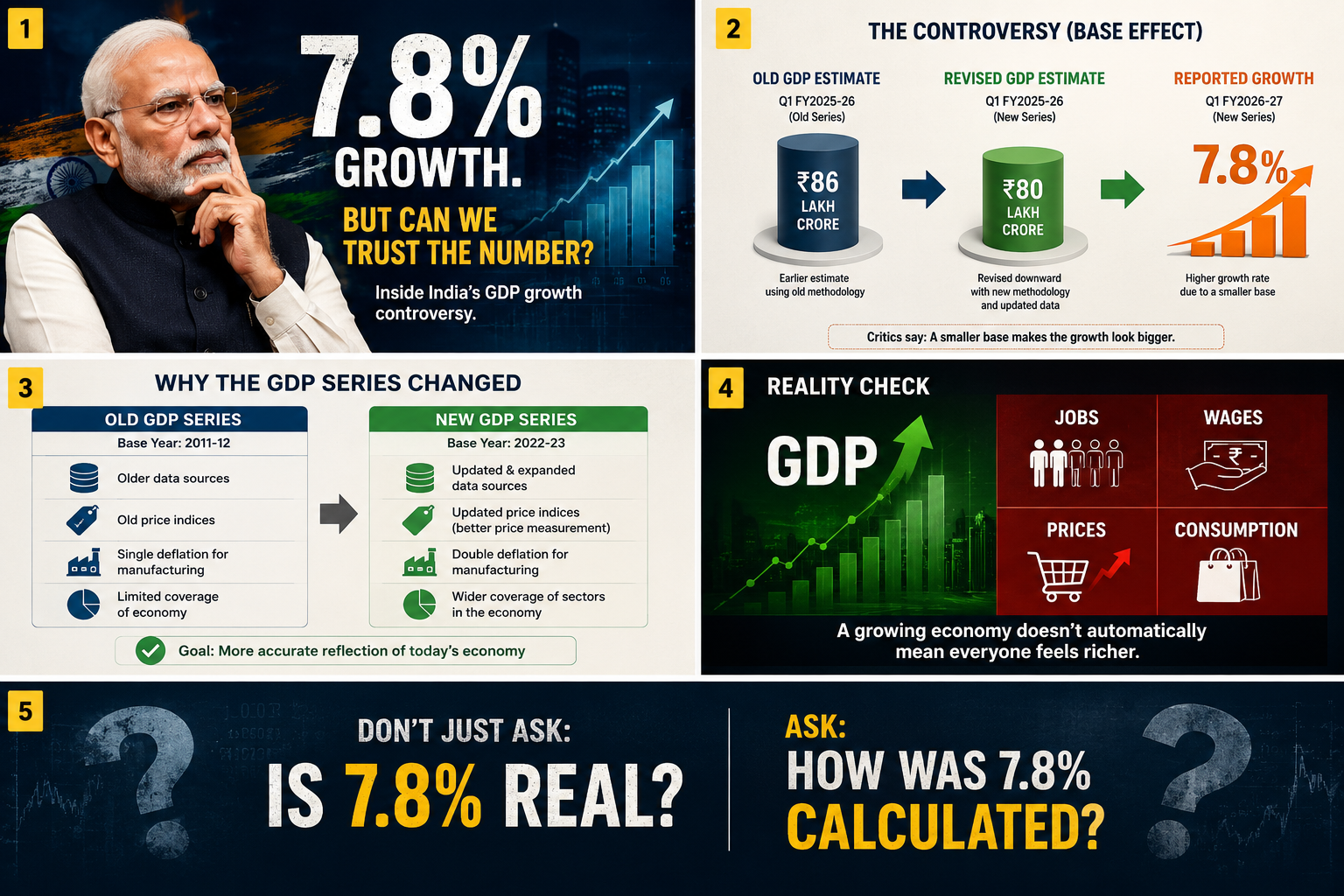
Under the older GDP series, Q1 FY2025–26 was estimated at around ₹86 lakh crore. Under the newer series, that figure has been revised down to roughly ₹80 lakh crore.
That matters because GDP growth is calculated by comparing one period with another.
A smaller base can make the growth rate look considerably higher.
Garg therefore argued that if the older figure were used as the comparison point, the growth would look dramatically lower.
This is where the internet quickly turned the story into:
“India’s GDP is fake.”
But that conclusion is much simpler than the actual issue.
So, is the 7.8% number fake?
Not necessarily.
And this is where things get complicated.
India introduced a new GDP series with 2022–23 as its base year in February 2026. The government says the new series incorporates updated data sources, broader coverage and changes in methodology, including more detailed price information and changes in how manufacturing output is calculated.
The government's argument is straightforward:
You cannot take a number calculated using the old methodology and directly compare it with a number calculated using the new methodology and then call the difference the actual growth rate.
In other words:
Don't compare apples with oranges.
The government has also pointed to other economic indicators, including manufacturing and services activity, electricity generation, cement and steel production, consumption and services, as evidence that the 7.8% figure is not simply a statistical invention.
Several economists have also pushed back against the 2.6% alternative calculation, arguing that it mixes the old and new GDP series.
But that doesn't mean there is nothing to question
This is perhaps the most important part of the story.
Rejecting the “GDP is fake” claim does not mean every question about the GDP data disappears.
The new series has produced significant revisions to historical numbers. That naturally raises questions about how those revisions were calculated, why the changes were so large in some periods, and whether enough information has been provided for independent observers to fully understand them.
Reuters reports that critics have also questioned the GDP deflator and whether the latest growth rate accurately reflects price changes across the economy.
And then there is an even bigger question.
What does 7.8% growth actually mean for people?
Because GDP is not your salary.
It isn't your savings.
It isn't the number of good jobs available.
And it certainly doesn't tell you whether life has become more affordable.
An economy can grow rapidly while many people still feel that their incomes aren't keeping up with expenses.
That is why the GDP debate matters beyond politics.
The real question shouldn't simply be:
“Is Modi's GDP fake?”
It should be:
“How reliable is the number, how was it calculated, and what does that growth actually mean for Indians?”
Those are three very different questions.
The bigger lesson
Statistics can look incredibly precise.
7.8%.
It feels like a hard, unquestionable fact.
But behind that number are definitions, datasets, assumptions, price adjustments, revisions and methodology.
Change some of those inputs and the story can look very different.
That doesn't automatically mean someone manipulated the data.
It means we need to understand how the number was built before deciding what the number means.
For India, this debate is worth having.
Not because 7.8% must be fake.
And not because the government must automatically be right.
But because economic data is too important to become either political propaganda or political ammunition.
The number deserves scrutiny.
And the scrutiny deserves facts.
So, what do you think? Is India’s 7.8% GDP growth a genuine reflection of the economy, or are there still questions that the government needs to answer?